
- One agent for the whole job
- It keeps working after you close your laptop
- Helper agents with their own email address
- Built into Gmail, Docs, Sheets, and the rest
- It picks the AI model for each job
- It plugs into the tools you already use
- Data work and reports
- Security, control, and spending
- Who's using it so far
- What we don't know yet
On October 8, 2026, Google Cloud introduced the Gemini agent at its Gemini at Work event. Google calls it "your new single, universal agent for work": one AI that answers questions, handles knowledge work, creates images and media, and writes and runs code, all from one place.
As with any launch, everything below is Google's own description of its product, not independent testing. Here's what Google actually announced, in plain English.
One agent for the whole job
Instead of a different tool for chatting, coding, and making images, Google wants one agent that does all of it. Its pitch is that work now starts in the prompt box: you give it a goal instead of step-by-step instructions, then come back to finished work. Google says you can reach it on the web, on your phone, on Windows and Mac, from the command line, and inside Google Workspace, Microsoft 365, and Slack.
It keeps working after you close your laptop
Google says the agent runs in the cloud, so a job that takes hours or even days carries on without you. It can also run on a schedule, or kick off when something happens, like a new email arriving. And it has memory: it keeps track of the conversation, builds up a knowledge base, and saves the how-tos it works out along the way, so it gets better at your team's way of doing things.
Helper agents with their own email address
This is the most unusual part. The Gemini agent can create temporary sub-agents, each with its own identity, to split a big job into pieces and work on them side by side. Google also describes "coworker agents": agents with a standing role and their own work email address, calendar, and storage. Colleagues can mention one in a Chat group or hand it a task the same way they would a person, and it can only see what has been shared with it.
Google's example is a marketing manager asking an events-coordinator agent to draft a launch plan, which the agent then posts back to the team.
Built into Gmail, Docs, Sheets, and the rest
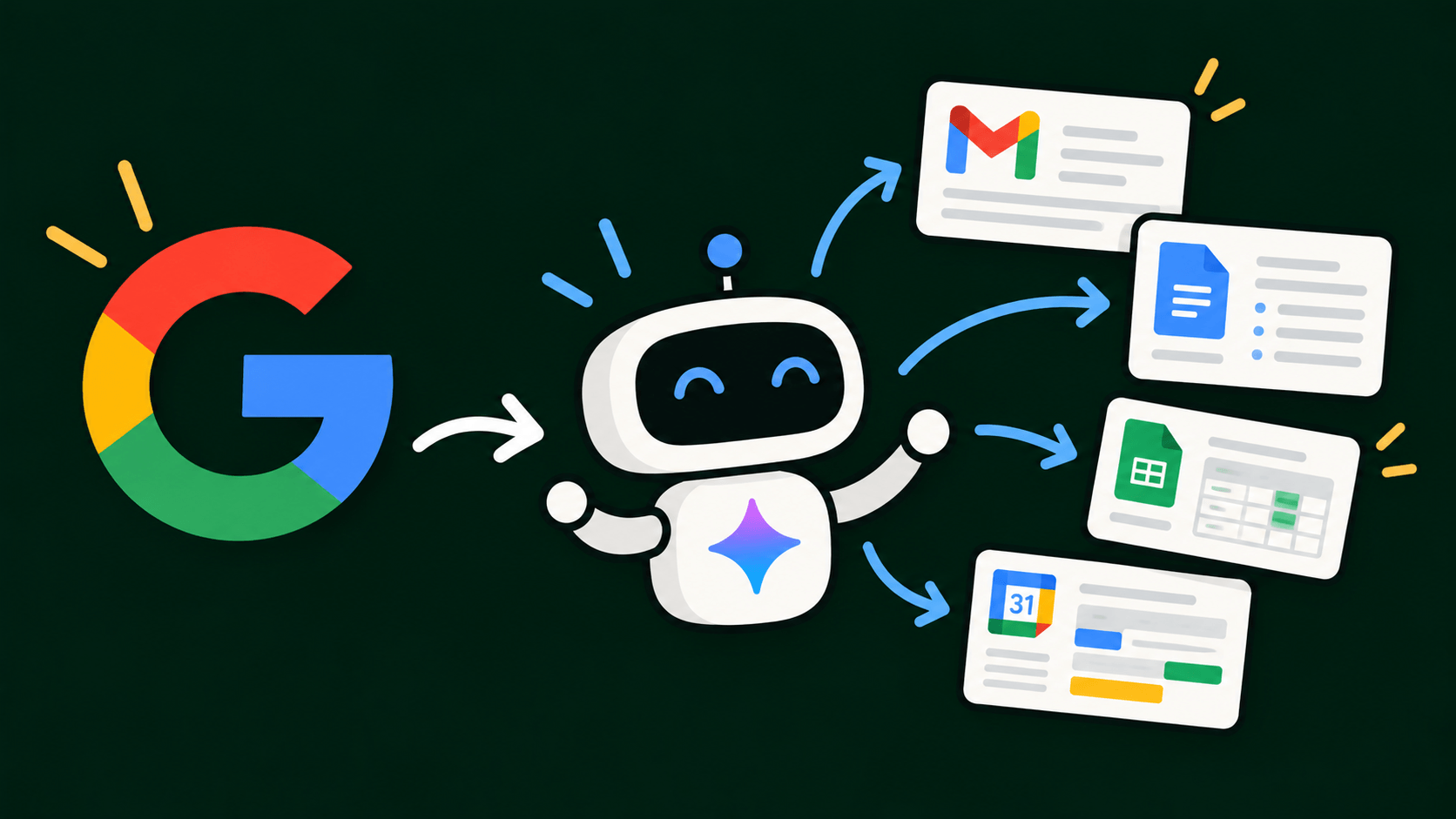
Inside Google Workspace (Gmail, Drive, Docs, Slides, Sheets, Chat, and Calendar), Google says the agent works in three ways. As a personal assistant, it can schedule a meeting with your usual team without you listing names or emails, then sort out times with people outside your company. As a proactive helper, it spots tasks it could take off your plate, like updating a slide deck, and offers to do them with one click. And as a team member, it has its own Workspace account, as described above.
It picks the AI model for each job
Google says the agent chooses the best model for each task, and today that includes Google's own Gemini models and Claude models from Anthropic, with other private and open models planned. It also says smart routing sends each job to the model that gives the best result at the lowest cost.
It plugs into the tools you already use
Google lists connections to Slack, Jira, Salesforce, ServiceNow, Confluence, Microsoft Office and Teams, and Git, plus data tools like BigQuery, Snowflake, Databricks, and Postgres. It also works with any tool that supports MCP, a common standard for plugging tools into AI. Companies can publish their own tools and their own "skills" too, which are reusable sets of instructions the agent can follow.
Data work and reports
For data teams, Google says the agent can write code, build notebooks, train models, and fix broken data pipelines. For everyone else, it can turn a request into a saved report that runs again later without extra cost. Google also quoted Bloomberg Media's CTO, who said that giving the AI trusted business context lifted the accuracy of its database queries by 63% in early development.
Security, control, and spending
Google puts a lot of weight on keeping this in check. Each agent gets its own identity and permissions, and everything it does is logged under the agent's name rather than a person's. Agents run in a sandbox, and Google says all their traffic passes through an Agent Gateway, a kind of firewall for AI agents that enforces a company's rules in real time.
On spending, Google says companies can set a hard limit per project. When it's reached, the agent pauses, and it can be resumed with one click. Google also says the cost per unit of AI has dropped 98% since 2024, but that usage has exploded, which is why it's pushing cost controls so hard.
Who's using it so far
Google says specialized versions are in preview for financial services and legal work, with government, healthcare, and retail coming soon. The announcement named finance customers including Deutsche Bank and CME Group, and legal partners including Harvey and Onit.
Google also shared results from companies using its enterprise AI products more broadly, such as Bradesco cutting document review from an hour to five minutes and Commerzbank cutting some reviews from 20 hours to one. Those are Google's figures, and they aren't necessarily from this new agent.
What we don't know yet
Google didn't say when the Gemini agent will be widely available, what it will cost, or which plans will include it. It's aimed at businesses first, not everyday personal use. If you're choosing an AI assistant for yourself right now, our ChatGPT vs Claude vs Gemini comparison is still the better place to start.